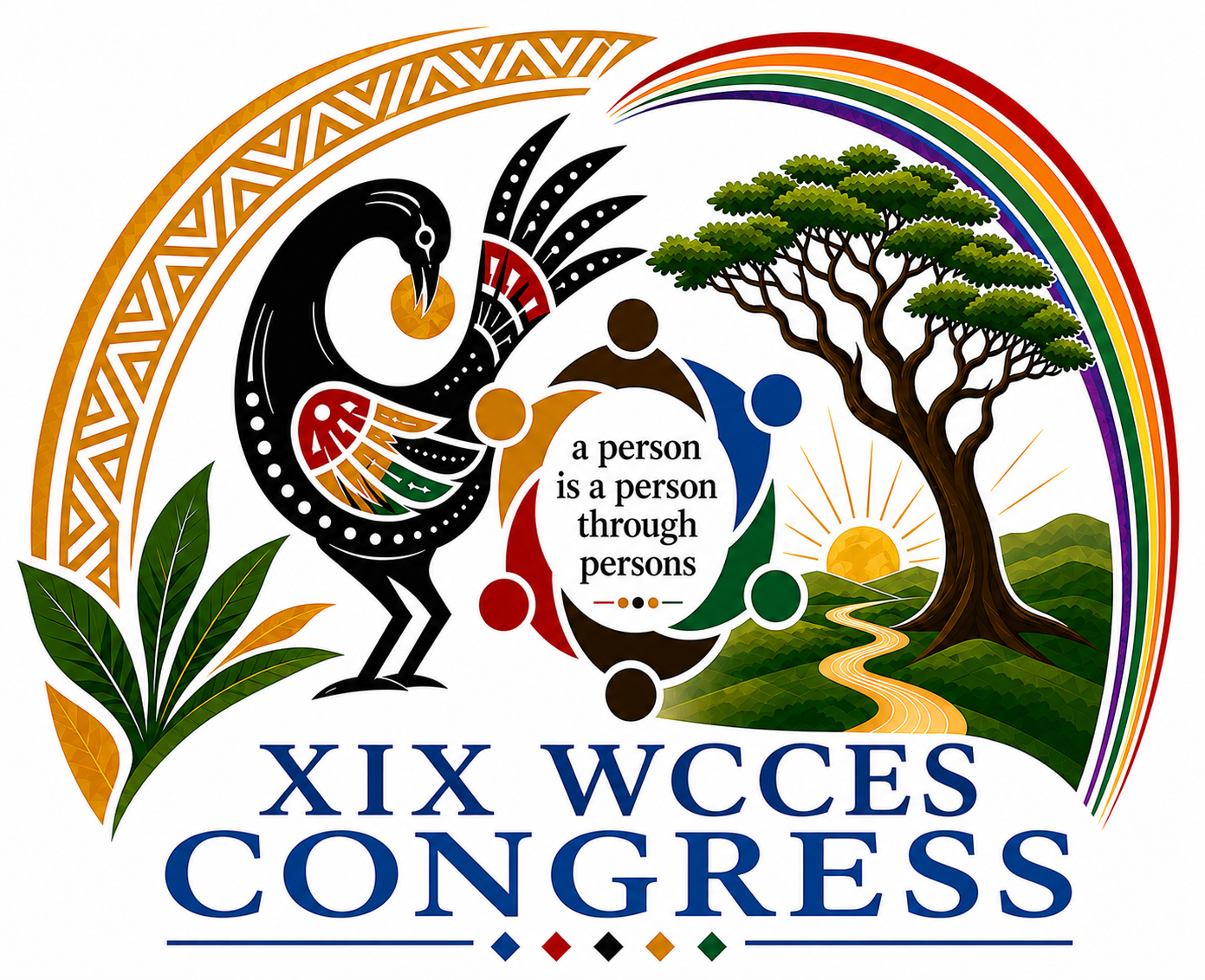
To present the theme of the 2027 Congress of the World Council of Comparative Education Societies (WCCES), it is fitting to begin by recalling the philosophical underpinnings of uBuntu, with its vision of the indivisibility of humanity within a world conceived as a complex whole, characterized by an interdependent ecosystem encompassing human beings, nature, the planet, and the entire universe. The state of the world in 2026 attests to this profound global interconnectedness across a wide range of social institutions and processes, including education, the economy, security, health, and holistic well-being that leads to flourishing: the full realization of human potential in community, marked by abundance, growth, and joy, understood not merely as the absence of harm but as the full expression of what it means to thrive together. Such interconnectedness has significant implications for the conceptualization, design, and practice of education, shaping its purposes as well as the systems through which knowledge is created, transmitted, acquired, and utilized.
Education also possesses an intrinsic temporal dimension, one that is aptly captured by the concept of Sankofa, which emphasizes the importance of drawing on the wisdom of the past to inform present action and shape a more equitable and purposefully designed future. This temporal orientation is understood not in simple linear terms, but rather through a circular ethos in which the past, present, and future are in continuous dialogue, each informing and enriching the others. Within the converging philosophical vision of uBuntu and Sankofa, individuals and social groups whose members are bound by shared characteristics, nation-states, and regions of the world, regardless of the side of history on which they have stood in shaping the contemporary world, are expected to have both the humility and the responsibility to engage in critical reflection on the past.
The current state of our world requires pausing to examine how and why we got where we are in order to change gears for our collective well-being. It is to this introspection that Global Africa CIES invites the worldwide comparative education community, on behalf of WCCES. The philosophy of Sankofa, rooted in the wisdom of the Akan people in West Africa, offers a comprehensive framework for engaging in this process. Such historical reflection is not an exercise in nostalgia or regret. Rather, it is a strategic and transformative process that equips individuals, communities, and societies with the knowledge necessary to chart a future for global flourishing.
The African American historian John Henrik Clarke (1996) captured this orientation powerfully: history is simultaneously a clock and a compass. It measures the passage of civilizations while providing direction for future action. The egg the Sankofa bird carries represents both the wisdom of the past and the future: the continuity of life, and the responsibility entrusted to each generation to transform historical knowledge into strategies that ensure the well-being of future generations. This is true for Africa and for all communities and regions worldwide.
Social institutions are among the most effective instruments for giving meaning to Sankofa, with the aim of forming a globally interconnected community in the spirit of uBuntu. Education, be it formal, non-formal, or informal, from infancy to adulthood, plays a central role. Throughout history, education has functioned as a double-edged instrument: used for domination, yet also inspiring resistance, social justice movements, democratic participation, and intellectual freedom. Education carries the potential to become a transformative force for the well-being of all living beings on our planet, animated by the spirit of mutual respect and deep interconnectedness.
Engaged Comparative Education and the Work Before Us
The XIX WCCES World Congress places Engaged Comparative and International Education at the center of its intellectual project — a mode of comparative education scholarship and practice that is historically grounded, attentive to identity, and oriented toward the genuine transformation of educational systems to serve the well-being of all.
This Congress extends a genuine invitation to scholars, researchers, policymakers, practitioners, and knowledge-holders from every region of the world. The wisdom embedded in Sankofa and uBuntu is not the exclusive inheritance of any single people or region. Across the globe, human communities have independently arrived at analogous understandings: that renewal requires memory, that the future is inseparable from the past, and that flourishing depends on the strength of the relationships that sustain us. Participants are invited to bring the full breadth of their own knowledge traditions into meaningful dialogue.